Showing posts with label Movie Themed. Show all posts

Sunday, May 20, 2018

Round Robin Roundabout

In National Lampoon's European Vacation, Clark Griswold drives his family around the Lambeth Bridge roundabout for hours, unable to maneuver his car to an escape road. I tried to find an alliterative synonym for obsession, but the English language has only so many words and none seemed to fit the bill, so I went for this English landmark for a more figurative version of being stuck in a rut.

Last year, during the club championship qualifier, I looked up the round robin tables. In the past, while assisting with the organization of the chess club, I had typed the numerical pairings found in the USCF Rulebook into an Excel spreadsheet and then done search-replace operations to make pairings using the players' names instead of just their seed number. While laboring to retype a 7-player double round robin and a 16-player single round robin, Mother Necessity whispered into my ear, "This should be automated by a computer." But I could not find a website through a Google search that specifically generated the Crenshaw pairings used in chess.

So I set about writing one of my own. The reference that was most useful was Wikipedia's page on round-robin tournament. In it, the process for Standard, Berger, and Crenshaw round robin pairings is described. Using javascript, I implemented algorithms that generated these 3 types of tables. During the process, I learned many items of minutiae, which is the meat of this post. Those of you who are already bored can read this list and quit, since the remainder of this post is going to be tracing and retracing my steps on my own mental roundabout.

  • Standard round robin uses incremental rotation, while Berger rotates the field halfway around the circle. Crenshaw pairings are just Berger pairings in reverse chronological order.
  • The USCF 4-player and 6-player round robin tables are not generated by the Crenshaw algorithm. The 4-player printed in the rulebook is Standard algorithm. The origin of the 6-player table is shrouded in myth with advantages and disadvantages.
  • The reversal table is only used when the round robin has an even number of players and one player withdraws before playing half of the games. It is possible to create an algorithm to make the reversal tables as well as the pairing tables.
  • Generating the tables and the reversals helped me detect about a dozen typographical errors in the Fifth and Sixth Editions of the USCF Rulebook.
  • A man named Warren J. Porter has created his own round robin system and on his own website placed his name among Berger and Crenshaw, but Wikipedia and the USCF have yet to recognize his innovation.

The most basic way to set up a round robin uses a Standard Algorithm. Put player 1 in a stationary chair. Line up the first half of the n competitors next to him, 2 through n/2. Then come back in reverse order pairing n/2+1 against n/2 until n is facing #1. Next round, everybody rotates clockwise by 1 seat except #1, so that #1 plays n-1 and n sits next to 1 and plays against n-2. The Wikipedia article has good pictures to see this rotation. The Berger tables use a different set of iterative steps. The field is laid out like the Standard, but after round 1, the last player is held constant, while everybody rotates clockwise by n/2 seats. The Crenshaw tables, at least for n>6, are basically identical to the Berger schedule, just in reverse chronological order. In Javascript, these algorithms translate into the following statements:

var seeds = [1, 2, 3, 4, 5, 6, 7, 8];
var half = seeds.length / 2;
var rounds = seeds.length - 1;
var schedule = [];
for (var i = 0; i < rounds; i++) {
  var top = seeds.slice(0, half);
  var bottom = seeds.slice(half, seeds.length);
  bottom.reverse();
  schedule[i] = [];
  for (var j = 0; j < half; j++) {
    var pair = top[j] + "-" + bottom[j];
    schedule[i].push(pair);
  }
  //now we rotate
  var addon = seeds.splice(-1); //Standard algorithm rotates the last player...
  seeds.splice(1, 0, addon[0]); //...into the second position
  //Berger and Crenshaw rotate the field halfway around
  if ((type == "Berger") || (type == "Crenshaw")) seeds = bottom.slice(1).reverse().concat(top).concat(addon);
}
if (type == "Crenshaw") schedule.reverse();

At the end of the algorithm, the pairings will be stored in a two-dimensional array named "schedule[r][b]" where the first index refers to the zero-based round number and the second index refers to the zero-based board number.

Once I got the algorithm to work and output to a readable form, I noticed a couple discrepancies in the USCF tables for 4-player and 6-player round robins. The 4-player table is simply the Standard 4-player table. The 6-player table is weird in that seeds 1-2 meet in round 1 while they meet in the penultimate round for tables 8-24. This would seem to be a defect of the table, especially if you have seeded players into the round robin in descending rating order. However, the USCF tables also carry a not-so-useless provision that if a player drops out of an even round robin before playing 50% of the games, late-round reversals can help mitigate color imbalances.

  • The custom 6-player round robin table, unlike most round robin tables pairs seeds 1-2 in round 1 instead of the penultimate round like all the rest of the tables. This would seem to be a defect with the pairings if you have chosen to seed your players by rating order instead of by lot. However, the reversal table has all the reversals in the final round 5. When the 6-player table is generated by algorithm, some of the reversals occur as early as round 3 of 5.
  • Aside from the idiosyncrasies of the 4-player and the 6-player, the algorithm generates tables with players 8-24 with basically no error.
  • The reversal tables of the 10-player and the 14-player are sorted in such a manner that my algorithm is at a loss for matching it.
  • In the Fifth Edition USCF rulebook, on page 296, it should say, "Color reversals should be made in the last three rounds if someone withdraws before playing five games."
  • Also in 5th Ed., on page 298, the 14-player PAIRING table, round 1, board 1, should say, "7-14" as the pairing, not "7-4".
  • In 6th Ed(p 323) and 5th Ed(p 301), in the 18-player REVERSAL table, when #13 withdraws, the first pairing to reverse should be 18-1 instead of 8-1 (1-8 is a round 10 pairing). Also, when #14 withdraws, the second pairing to reverse should be 13-6 instead of 13-16 (13-16 is a round 7 pairing).
  • In 6th Ed(p 325) and 5th Ed(p 303), in 20-player REVERSAL table when #10 withdraws, the pairing to reverse should be 15-6 instead of 15-16 (15-16 is a round 9 pairing).
  • In 6th Ed(p 326) and 5th Ed(p 304), in the 22-player PAIRING table, in the 18th round, the second to last pairing should be 1-4 instead of 1-14 (1-14 is a round 8 pairing).
    • In 6th Ed(p 328) and 5th Ed(p 306), in the 24-player PAIRING table, many pairings in rounds 21-23 have typos, specifically:
    • In round 21, 10-17, 11-16, 12-15, and 13-14 instead of 0-17, 1-16, 2-15, and 3-14.
    • In round 22, the second to last pairing should be 23-3 instead of 23-2 (2-23 is a round 23 pairing).
    • In round 23, 10-15, 11-14, and 12-13 instead of 0-15, 1-14, and 2-13.

I have made a web application that produces the tables and reversals algorithmically at http://www.symbiosis.elementfx.com/projects/roundrobin2/RoundRobin.htm.

Practical Rook Endgames 17: Cure a Vancura Amnesia

In the 1990 "Total Recall" starring Arnold Schwarzenegger, the main character encounters a video recording of himself lifting the veil on his amnesia, his real identity and the lie he was until recently living.

I was watching the St. Louis Chess Club's YouTube coverage of the 2018 U.S. Championships. In round 7, Zviad Izoria had this position with white to move against Hikaru Nakamura. Study the position and then watch 6 minutes of the broadcast from when White moves Rh8 until the game ends in a surprise.

FEN: 8/2k2K2/2P4R/2r4P/8/8/8/8 w - - 1 88

When Vancura was mentioned, I searched my memory and could only find a hazy mess despite having blogged about Vancura here and here. So I went back to a Vancura stem position with white: Ra8, Pa6, Kf4 and black: Ra1, Kg7, and this time I tried to create a more thorough treatise using the Shredder endgame tablebase and playing through plausibly interesting variations. The result of my effort is this one-page memory refreshment PDF tool of variations related to the Vancura position. It's not quite as vivid as Schwarzenegger's video recording, but this is the mnemonic device that should help stave off my next bout of Vancura amnesia. Now that I know a little more about Vancura, I'm going to comment on the commentators. Here is the blow-by-blow discussion with YouTube time indexes:

5:40:12 Maurice Ashley notices white playing 88. Rh8 dropping the c-pawn, going for an h-pawn win. Since the black king has the c-pawn blockaded, white's best chance for victory is the distant h-pawn.
5:40:16 Jennifer Shahade mentions a winning skewer trick. The Seventh Rank Skewer trick is one of the weapons in the stronger side's arsenal. It only comes into play when the weaker side tries to move his king to the pawn too early and steps on one of the two central files (d- or e-). The stronger king also tends to be out of the picture so that the skewering happens without interference. The skewer doesn't come into Izoria-Nakamura. I mentioned the skewer before in this blog post.
5:40:17 Yasser Seirawan says that the black king is so far away. In many variations, the draw or win depends upon a king race to a key Bishop-7 square. If the weaker king can stay within a knight's move of the stronger king, he can usually draw.
5:40:19 Awonder Liang on post-game interview couch suggests the position is "similar to Vancura". Similar to Vancura is as close as it gets.
5:40:27 Yasser disputes the closeness to Vancura. Awonder gives the line 88... Rxc6 89. h6 Kb7. 88... Rxc6 actually occurred. Had Izoria played 89. h6? Nakamura could have obtained a drawing Vancura with 89... Kb7!, the only move that draws! One of the reasons I find some of these endgames so fascinating is how moves can be both precise and counterintuitive at the same time. Vancura was only one move pair away from the actual game.
5:40:50 Yasser suggests 89. Re8 (build a lateral rook bridge) Building a lateral rook bridge is one technique to win. Usually, the defending rook has abandoned his order to keep the pawn under observation and is trying to get into Vancura lateral checking position.
5:40:54 Jennifer agrees 89. h6 might be the wrong move. 89. h6? is drawn with best play.
5:40:01 Yasser gives the line 89. Re8 Rh6 90. Re5 intending Kg7. The Shredder tablebase notes that 90. Re5! is the only move still winning for white.
5:41:10 Maurice adds 90. Re5 Kd6 91. Kg7 "just nails him". Yasser agrees "just nails him". Shredder says 91. Kg7? is drawn simply by 91... Kxe5! 92. Kxh6 Kf6!. The weaker king never allows the stronger king to move Kg7 or Kg8. If the stronger king does get Kg6, then he'd better be on his way to h8. e.g. 93. Kh7 Kf7 94. h6 Kf8! 95. Kg6 Kg8! and the weaker king can mindlessly play Kg8-Kh8-Kg8 until he gets stalemated. Shredder says 91. Rf5 keeps the win alive.
5:43:20 Yasser notices play continued 89. Kg7 Rc1. Jennifer starts analysis with 90. h6. 90. h6 is correct.
5:43:57 Maurice declares that "h6 is a draw." Shredder disagrees. In fact, at no point after 88. Rh8 did white let the win slip.
5:44:00 Yasser questions the draw assessment. Maurice says the black king might be close enough to draw. The black king is one tempo short of drawing.
5:44:11 Yasser extends the line 90. h6 Rg1+ 91. Kh7 Kd7 92. Rg8. The position of the stronger side's pieces is sometimes Pawn at rook 6, King at rook 7, and Rook at rook 8 while the weaker rook harasses from the knight file. The winning method often reorganizes these pieces starting with Rook to knight 8, King to knight 7 and if checked, King to rook 8 and then pawn to rook 7. It looks as if the king has castled by hand into a tight formation hugging the corner of the board. I used the moniker "Fortress of Solitude" for my mnemonic here. 92. Rg8! is the only move that wins.
5:44:29 Jennifer and Yasser agree that the black king is too far to draw. Correct.
5:45:11 Yasser comes up with the plan of Rg8, Rg6, Kg7, and queens. Black can throw a monkey wrench into this plan. Concretely, 92. Rg8! Rf1 93. Rg6? gives up a draw to 93. Ke7.
5:45:30 Maurice tries to draw with the plan 90. h6 Kd7. Yasser extends with 91. Rg8 Ke7 92. h7
5:45:44 Nakamura lets his clock run down to 2 seconds before recovering a 30-second increment. Maurice says "Nakamura's never going to flag." Never say never.
5:46:02 Maurice agrees that after 92. h7, the White King will win with a "laddering back" maneuver. With the weaker king at e7, the stronger king "ladders back" through harassing checks with Kg7-Kh6-Kg6-Kf5 and down to f2 if necessary.
5:46:20 Maurice mentions the queen versus rook ending. Jennifer asks, "Wait did you say there's a way to force queen versus rook?" Jennifer's question goes unanswered during the broadcast because of what happened next in the game. From the game continuation 90. h6 Rg1+ 91. Kh7 Kd7 92. Rg8! Rf1 93. Kg7 Rg1+ 94. Kh8 Rf1 95. h7 Ke6 96. Kg7 Rg1+ 97. Kf8 Rf1+ 98. Ke8 Rc1 99. Rg6+ Kf5 100. Rf6+ Kxf6 101. h8=Q+ Kg6 starts a complicated Queen versus Rook that is likely to become my next Endgame Obsession.
5:46:30 Nakamura flags just before playing 92... Re1. Maurice's head just about exploded when he learned that Nakamura had flagged.

Tuesday, April 17, 2018

Checkmate Nitpick

I fell for the trap of thinking that a chess movie starring Danny Glover and Sean Astin on Netflix couldn't be that bad. I probably fast forwarded through the last 30 minutes, but I still regretted the time I lost on it. No need to warn you of spoilers because I'm really doing you a service if you never watch this turkey. Mash up a bank robbery plot, a family disintegrating in the midst of a health crisis, and a high stakes chess game, and you'd probably do better than what director Timothy Woodward Jr put together. I should have read the reviews before I hit play because it's basically a string of the lowest ratings you could give.

I found myself shouting at the television screen because for a movie with a chess-themed title, they sure didn't know chess. Here are a couple of screenshots to play at home:

1. Vinnie Jones is sitting behind the black pieces awaiting his opponent. What's wrong with this picture?

2. Danny Glover arrives at the opposite side of the board and sets a case down. There are two things wrong here.

Answers

1. The black king is on Vinnie's right and the black queen is on his left. Standard setup should always have it opposite.

2. The player of the white pieces brought his own half-set which happens to match the style of the black pieces; this never happens because no one breaks up sets. The right lower corner nearest to Danny Glover should be a light square.

1 star for spending money on named cast members, 0 for skimping on writers who could put together plot, characters, or dialog. I still don't know why the chess game had any relation to the rest of the movie, but you know what? I just don't care.

Saturday, May 13, 2017

TPS Report #20

A friend I hadn't seen in a while showed up at the club and congratulated me on my recent successes. I confessed that despite the success, my relationship with chess had been languishing toward ennui again. Having finished the tournament and rated the results, I have to remind myself of the good things.

After the year of no rated tournament games, I jumped into club games with the 2016 Holiday Swiss starting after Halloween. After a good 10.0/12 run in the Club Championship Qualifier, I now have the highest rating of my career at 2135. The statistics seem to be stacking up to say that I have made a quantum leap, but I worry that crowing about good things calls the attention of the karma-balancing forces. Here is one version of the cherry-picked statistics:

Opponent ClassPre-2004 (N=206)
Performance Rating
2004-2013 (N=240)
Performance Rating
2014-2015 (N=89)
Performance Rating
2016-2017 (N=17)
Performance Rating
Class B1877196320841949
Class A1885207820732200
Expert2005196421472263

In 2004, I volunteered to do the games bulletin for the master tournament in Reno. I had to annotate somewhere around 60-100 games between players in the rating range of 2000-2600. I think the two things that struck me most were how efficiently the masters moved their pieces in pursuit of their plans and how relentlessly their technique converted advantages into points. 2004 was the year I gave up the Sicilian in favor of the Modern Defense and I think 2004 was also the year that I fell in love with the endgame. In retrospect, my technique improved at beating the players in Class B and in Class A. However, playing against fellow Experts was a misery since I was only an Expert by virtue of a prize rating floor and I often felt outclassed.

In 2014, I gave up the English Opening and the Modern Defense in favor of more open, tactical games. I also started systematically studying and reviewing my opening repertoire with Chess Position Trainer, developing my own opening theory, and familiarizing myself with key positions and themes. I think that was the year that I began to fear Experts less and turn a losing percentage against them (37%) into a winning one (58%).

I don't have an explanation for what happened in the past 7 months, but I seem to more consistently avoid the emotional attitude of "I'll just make this move, see what happens, and hope it turns out right." My job is to know as well as possible what will happen and in as much as I had chances to avoid worse and losing variations, I seem to be capitalizing on a reduction in my mistakes. I'd like to say that some of my recent work with endgame studies has improved my kinetic linking to see further and clearer. Conversely, my opponents seem to be making disastrous mistakes more frequently. Or maybe I have improved at spotting opportunities.

Of course, there is still room for a regression to the mean since the N-number is small for the 17 recently picked cherries. Still, with my tendency to accentuate the negative, it's therapeutic to highlight the positive.

Going forward, I will try to mentally rest for a few weeks until the championship matches. Perhaps I will blog about more interesting and practical endgames that have come up in my games and in those of the masters.

Thursday, April 6, 2017

Tomb Raider Revisited

I have been watching the Saint Louis Chess Club's YouTube coverage of the 2017 U.S. Chess Championships. In round 8, Ray Robson played a Gruenfeld Defense against Alexander Onischuk. After 1.d4 Nf6 2.c4 g6 3.Nc3 d5 4.cxd5 Nxd5 5.e4 Nxc3 6.bxc3 Bg7 7.Nf3 c5 8.Be3 Qa5 9.Qd2 0-0 10.Rc1 Nd7 11.Bd3 b6 12.0-0 e6 13.Qe2 Bb7 14.Nd2, they reached this positon:

Ray Robson decided to raid the two pawns at a2 and c3. I'm not sure where he thought he was getting away with the loot, but the tomb closed up and Ray's Raider got trapped 14...Qxa2 15.Ra1 Qb2 16.Rfb1 Qxc3 17.Nc4!

I think Onischuk speculated that Robson might have missed 17.Nc4. Play could have progressed with 17...b5 18.Ra3 Qb4 19.dxc5! Qxb1+ 20.Bxb1 bxc4 21.Qxc4 with only +1.15 pawns to White.

Instead, Robson tried to get out with 17...Nf6? 18.Ra3.

It struck me here how similar the queen trap here is compared to the one in my own game. Not completely analogous, since I know there is a difference between Qb3 and Qc3. And now Robson played his own knight desperado 18...Nxe4

Unfortunately, the tactics are all in Onischuk's favor at this point. 19.Bxe4 Bxe4 20.Rxc3

Eventually, the game traded down to Queen and the 3 white kingside pawns versus Rook and the 4 black kingside pawns. Someone mentioned a fortress, but White forced some pawn exchanges and the Black king became too exposed to wait out the siege.

Monday, March 20, 2017

Tomb Raider

The Tomb Raider franchise began in 1996 when game studio Core Design released under its parent company Eidos Interactive, a third-person 3D action adventure featuring acrobatic (and shapely) Lara Croft as the Tomb Raider navigating through traps. Since that time, the franchise has gone on to publish about fifteen game titles and inspire two movies starring Angelina Jolie. A reboot of the film franchise is in development with Alicia Vikander (from Ex Machina) in the title role.

I won a game last month that reminded me of the Tomb Raider. My opponent offered material for the possibility of trapping my queen. I stayed one step ahead of the traps and managed to escape with the material advantage intact. I'm playing Black. White's 20th move was 20.Qc2-e2, loosening the protection of the Nb3, to which I responded 20...Qc7-d7 threatening to capture the white pawn on a4 and having a follow-up threat against Nb3 for the next move. Notice that Black has a loose a7 pawn.

My opponent and I were both a little short on time, about 15 minutes to make 10 moves and reach move 30. Ideally, both sides could sink into 30-45 minute thinks and try to work out the next 8-12 plies with some level of certainty before making such committal moves. Barring that, I fell back on intuition that I could use the pawn exchanges at e4 and b4 and my well-placed rooks at c8 and d8 to aid my queen's escape. If the two white rooks came to a1 and b1, the bishop would have trouble discovering the attack of the b-rook because a1 was occupied and Bc1 allows simply Qxc3. If the minor pieces could not trap my queen, then I might be able to sac my queen for a rook, thereby gaining at least material parity. I also used a rough risk-reward calculation: if I took on a4, worst case scenario was that Ra1 forces my queen to retreat to d7 and then I would have to contend with Rxa7. So, sometimes, I used shorter variations than I really should have to substitute for calculated certainty. My opponent sweetened the reward by cutting off the protection of Bb2. 21.Nc2??

I knew that I was getting the a-pawn and at least positional play against a pair of awkward knights (if either knight goes to a1). If he tried to trap my queen with Ra1, I would get the Nb3 and tempo against the loose Bb2. So I took the bait and entered the tomb. 21...Qxa4 22.Ra1

Last chance to bail out with Qd7 Rxa7. No guts no glory. 22...Qxb3 23.Reb1

White is one move away from trapping the Black Queen with Ra3, but Black has several resources to delay that outcome. The most immediate is cxb4. This has the possibility of opening the c-file for the Black rook and it also temporarily prevents Ra3. However, White would almost certainly play Nxb4, keeping the c-file semi-closed. Another resource is dxe4, temporarily giving Black the potential of Qd5, but fxe4 leaves the queen trapped. I already began to see the possibility of a bailout sacrifice to get my queen out of trouble, but I wasn't sure it was going to work. So I went for the pawn exchanges to improve my rooks. 23...dxe4 24.fxe4

24...cxb4 25.Nxb4

A pause now that we're five moves closer to time control. I was annoyed at the weakness of my a7 pawn and the tempo that Rxa7 might get on my Bb7. Since I was already up a knight and a pawn, I calculated that 25...a5 26.Ra3 Qxa3 27.Bxa3 axb4 might be a bailout strategy. Do you see the other possibility of bailout yet? 25...a5 26.Ra3. White moved in to kill my queen.

Even though 26...Qxa3 27.Bxa3 axb4 28.Bxb4 carries the material advantage of queen (9) for rook and two knights (11), White's position seemed annoyingly consolidated. I couldn't see how I was going to organize my pieces for the next round of battle. With White's Nb4 under attack and both our time troubles becoming serious, I decided to play my ace in the hole. 26...Nd4!.

If he captures my queen with Rxb3, I capture his queen with check Nxe2+ with more even exchanges helping Black's endgame. If he captures my knight with cxd4, I capture his knight Qxb4 and get my queen away safely with the knight advantage. If he saves his queen, I save my queen with Qe6. My opponent let his time tick down to about 1 minute for 4 moves as he tried to work out this mess. He finally settled on 27.Qd2 Qe6.

At this point, I figured that White should trade knights and gain a protected passer at d5, e.g. 28.cxd4 axb4 29.d5. Another variation could have gone 28.Nc2 Nxc2 29.Rxc2. However, with his time trouble, White tried too hard to avoid exchanges and came up with a move that made his knight, bishop, and rook awkward. 28.Na2?

With the remaining time on my clock, I retreated while picking on the awkward rook. 28...Nb5 29.Ra4 Nd6 30.Qf2 Bc6. With a piece and a pawn down and the possibility of losing the rook, my opponent resigned. Black's most straightforward win goes 31.Ra3 Nb5 32.Ra4 Qb3 going back to the tomb to loot more treasure.

Monday, March 13, 2017

Brazil

Terry Gilliam's "Brazil" is a movie about a dystopian, Kafkaesque world of bureaucracy, superficiality, and terrorism. The main character descends into criminality and madness when he tries to swim against the current using his conscience, passion, and resourcefulness. One of the images toward the end of the movie involves a heroic figure becoming enveloped and then consumed by flying scraps of paper, a metaphor for the triumph of bureaucracy.

One of my recent games involved enveloping an enemy piece in pins and cross-pins in order to eventually win. Here is the position after Black played 16...h5:

Sam Lowry (Jonathan Pryce) wakes up one night to find the central heating in his apartment has gone on the fritz and is now too hot. He leaves a message with the Central Services answering machine and goes to sleep with his head in the refrigerator.

Black seizes the initiative with a flank attack on White's g4-h3 pawn chain. Note that if g4-g5, Black has the fork Bf4+. 17.Nh4?!.

Sam is awakened by freelance outlaw repairman Archibald "Harry" Tuttle (Robert De Niro represented by the White knight) who tries to resolve the heating problem.

I think that my opponent wanted to try to exploit the hole at g6, but there is no time for that because the Black rooks are going to use the tempo Rh6 to assist in doubling on the h-file. 17...hxg4 18.hxg4 Rh6.

The call to Central Services goes through and two repairmen, Spoor (Bob Hoskins) and Dowser (Derrick O'Connor) are dispatched to Sam's apartment on a collision course with Harry Tuttle.
With some quick thinking, Sam rebuffs the attempt by Spoor and Dowser to bully their way into his apartment by requesting official paperwork, thereby preventing an armed confrontation with Tuttle. Tuttle zips away via a zipline.

White regroups with an awkward sequence: 19.Ng2 Reh8 20.Rg1?!. I mentioned after the game that White should have probably exchanged one pair of rooks so that I wouldn't get so much activity with the second rook on White's third rank.

Far from being defeated, Spoor and Dowser (Black's rook pair) keep showing up at Sam's apartment, once to pull all the ducting out of the walls, and then once more when the system has turned the apartment into a freezer. During the daytime, Sam spends all his efforts at work trying to track down the girl of his dreams, Jill Layton (Kim Greist).

Black's rooks soon lodge in White's position, first at h2 where it causes immobility in the Ng2 because of the looseness of f2. White tries to stabilize his weaknesses by moving his king from c1 to e2. This is double-edged in that his king becomes the target of pins and skewers. 20...Rh2 21.Kc2?! Be8 22.Kd2 Bg6 23.Ke2 R8h3 24.f3. With the third rank pressure preventing White from moving his Rd1 for fear of Bd3+, White blocks this coordination by advancing his f-pawn. But now the knight is pinned to the king.

With the aid of Sam's erratic behavior, Sam (White King) and Jill (King Bishop Pawn) run afoul of the law and are soon labeled as terrorists.

I'm somewhat proud of this next sequence which was not easy to find and advance the attack. The light-squared bishop is hindered by the f3 and g4 pawns. It would really like to participate in the attack on g2 and therefore belongs on e4 or h3, but there is currently no path. Luckily, a pawn break 24...f5! was handy, weakening the f3-g4 structure enough to become porous. Then followed 25.gxf5 Bxf5 26.Rdf1 Rg3 27.Rf2 Bh3.

Once 27.Rf2 appeared on the board, I had to calculate the possibility of 27...Bh3 being answered by Ng2 jumping. The trickiest jump is 28.Nf4 because it cuts the rooks off from their protection by the bishop on d6. At first I thought I had to trade both pairs of rooks 28...Rxf2+ 29.Kxf2 Rxg1, but I worried about 30.Nxh3. I couldn't see clearly enough to find 30...Rh1 which reopens 2 threats of Rxh3 and Rh2+ skewering the Bb2. But I was reassured when I found 28...Rxg1 29.Rxh2 Bxf4 30.Rxh3 Rg2+ 31.Kd3 Rxb2. Unfortunately, the next pair of moves were both blunders. White bluffed and Black blinked with 28.cxd5? exd5?. 28...Bxg2! would have been completely winning as Bxf3+ is difficult to meet. But finally, the White king walks into the trap that Black initiated with 20...Rh2. 29.Kf1. The knight is pinned again.

Sam hatches a daring plan to erase Jill from the Ministry of Information's databases. Unfortunately, Big Brother is more than a one-trick pony. Information Retrieval, e.g. police forces and interrogators, find Sam's hideout, break down the doors, and arrest him.

With the rooks and knight and king largely immobilized, the plan of Bd6-Bf4-Be3 seemed decisive. 29...Bf4 30.Re2. Here I missed the clever zugzwang 30...g5!. 30...Rxf3+ is enough to win, but my advantage falls from 5.9 to 3.0. 31.Rf2 Rxf2+ 32.Kxf2.

Sam finds himself about to be tortured. Suddenly a shot rings out and he is rescued by some commandos, including Harry Tuttle. There is seeming triumph over bureaucracy when Tuttle blows up the Ministry of Information buildings.

A semi-crucial move appears at this point of the game. If I had felt confident with all the pin pressure I had put on the Ng2, I still had to find my way to a winning endgame. The extra pawn at g7 could still win, but the ending should be bishops of same colors to win it. With that in mind, White must not be allowed to unpin the knight and capture Kxf4. Therefore, 32...g5! was necessary. My opponent said he thought he had a chance at this point, but the advance of the g-pawn shut down his last hope. The cocoon around the knight unravels, but the knight is also gone. 33.Kf3 Rxg2 34.Rxg2 Bxg2+ 35.Kxg2 g4

But the falling paper debris from the explosion envelops Tuttle and mummifies him like a spider's prey. Sam rushes to help, but by the time he unravels the paper, Tuttle has seemingly evaporated.
The authorities chase Sam until he finds Jill again and they escape to the idyllic countryside.

The game concluded with fairly simple plans of centralizing the Black king to f5, possibly e4, and trying to queen the g-pawn. The exploitation of two weaknesses is a common endgame principle. 36.Kf2 Kd7 37.Bf3 Ke6 38.Ke2 Kf5 39.Kd3 g3 40.Be1 g2 41.Bf2 Bh2 42.a4 g1=Q 43.Bxg1 Bxg1 44.b4 Kf4 45.Kc3 Ke4 and White resigned.

The unharmed faces of Sam's tormentors, Jack Lint (the Black King Bishop, played by Michael Palin) and Deputy Minister of Information Mr. Helpmann (the Black King, played by Peter Vaughan) interrupt Sam's fantasyscape, revealing that Sam has only escaped his torture by becoming completely delusional.

Tuesday, February 21, 2017

Vulture Culture

Temposchlucker's blog has spilled some digital ink (bits and bytes?) on vultures lately. I found this comment in a post entitled KISS:

The first state is when we circle like a vulture above the board and look with a disciplined mind at the board. We see, almost parallel, everything what's going on, without identifying ourself with whatever happens down there. We see the trains driving from station to station, and from above we can see all stations and trains at the same time (parallel).

The second state is when something catches our attention, and we jump on the bandwagon. From that moment on, we rumble from station to station in a sequential way. We are totally identified with what we see, and it feels as if our train is driving through a tunnel. We only know about the station we just left, and the station we are heading to, and what we can see sideways from the windows of our forth thundering train. Our attention progresses from station to station in a serial way, unaware of what is going on elsewhere.

In the language I'm used to, the vulture represents breadth of chess calculation, while the train represents depth of chess calculation. The goal of chess calculation is to miss nothing important, shallow or deep, and thereby play nearly perfect chess like the computers and Super Grandmasters. One kind of error in chess is the horizon effect, usually relating to computer search depth: a move looks good until you see three moves later that it is refuted by an inescapable sequence. This is the fault of the train in the analogy above. No one told us that the station three stops away was being repaired. For this post, I wanted to concentrate on the vulture because it relates more directly to errors of vision in chess and our quest to see those little Hobbitses that conspire to stay hidden:

One of the appeals of chess, or almost any board game, is that we sit surveying the board like gods above a miniature world. The chess world is populated by sculptures that are imbued with varying geometry of movement, as opposed to the uniform diagonal of checkers, or the character attributes of Dungeons and Dragons avatars. As opposed to information hidden in the roll of a 20-sided die, the information of chess is evident in the positions of the pieces with a tiny bit encoded in the history of that particular game (e.g. castling and en passant privileges). Vultures fly overhead and check out the lay of the land.

NM Dan Heisman states, ""The most important principle in chess is SAFETY; second is ACTIVITY; everything else on the board is relatively unimportant." Being a lumper, I interpret the activity of your own pieces to be the extent to which they threaten the safety of your opponent's pieces and vice versa. One piece's activity is another piece's lack of safety, so there is a reduction back down to a single principle of safety. As beginners, we start evaluating by counting the pieces. Pieces that are off the board don't count. They are effectively dead for the rest of the game. But before they are removed from the board, they can be in various states of health: convalescing in their home positions, immobilized by positioning in the corners or edges of the board, limited by enemy or frenemy forces, and at death's doorstep (en prise). In Go, groups of stones have Life and Death. Pieces in chess have safety and activity, death and life:

I find it ironic that the doctor in the comic uses the word "activity". As chess players, it is pretty much our job to notice when pieces are safe or unsafe, protected or loose, good and bad, strongly posted or insecure. As beginners, the first level of vulnerability we see in our opponent's pieces is the completely loose, unprotected pieces. Capture the free stuff is what I tell my beginning student.:

Especially in beginner-level chess, mistake-prone humans will leave material unprotected. All that is required at this level is being careful of your own pieces' safety and patience for your opponent to leave a piece behind to die alone the desert.

After a while, it's not enough just to wait for someone to drop something. Around Class A/B level, chess players get through entire games without blundering any material. In this environment, the vulture analogy breaks down a bit. It's no longer enough to be a scavenger. We have to upgrade to being predators. Alexander Alekhine is quoted as saying, "During a chess competition a chess master should be a combination of a beast of prey and a monk." Alekhine also said, "I think up my own moves, and I make my opponent think up his."

At least one article indicates that criminal predators choose their targets from the way people walk. Analogous to gait in a person, mobility of a piece on the chessboard depends on space, safe squares to move to, whether it is pinned to more valuable pieces, etc. When we capture a mere pawn, Aron Nimzovich spoke of an entire process, "First restrain, then blockade and finally destroy." So how freely a piece can move can often correlate with how vulnerable it is. If it is crawling, there is a good chance it might make a good meal for our vulture.

To broaden our definitions, sometimes the target in chess is not a moribund piece, but rather a key square. Vultures also need nice places to roost as well as the occasional carcass.

Computers have taught us that sometimes, positions that look hopelessly lost actually have hidden defensive resources in order to save a draw for the weaker side. Again, in Go, there is a state called Seki where two opposing groups of stones have features that cannot be resolved into Life and Death. These might be analogous to drawing fortresses or stalemate positions in chess. Investing in phantom possibilities is the flip side of being a vulture: when NOT to invest energy pursuing a line that evaluates unfavorably. The hypothesis must occasionally be nullified.

Draw! (gunslinging, art, and chess puns all intended). At the end of the game, what motivates us chess players is a desire for victory signified by the death of the opponent's king. In this pageant of flight, eyesight, error, opportunism, and death, the vulture is apt analogy.

Monday, February 20, 2017

Magneto's Prison

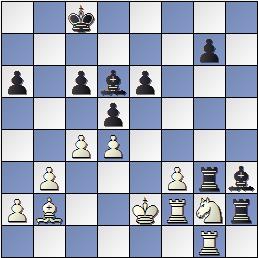
My first chess composition began while I was teaching a beginner how to checkmate with two rooks using the steamroller technique:

I wanted to test the student's ability to see how the pieces might protect each other from a double attack and so I presented this position. White to move and save both rooks:

As the beginner pondered how to save the rooks, I wondered whether such a position was possible with White to move, since Black's king is almost stalemated and he has no visible means to mark time. This got me thinking along the lines of retrograde analysis a la "The Chess Mysteries of Sherlock Holmes" by Raymond Smullyan. On top of the requirement for LEGAL moves in retrograde analysis, I wondered whether Black would make LOGICAL moves to get to this position, basically meaning can we get to this without White having to leave a rook en prise for one or more moves? I answered both questions with this new setup and sequence of moves. White to move and get to the diagram above:

1.Rf3+ Kxg4

With my current reading of Kubbel's 150 Endgame Studies, I decided to make a little composition and ran through many possible movie-themed or atomic-themed names to give a worldly root to my abstract composition: Phantom Zone a la Superman 2; hydronium ion with 2 electrons around 1 proton; maybe just helium; unobtainium which is mentioned in James Cameron's Avatar and in The Core; maybe Bose-Einstein condensate in the movie Spectral. Finally, I decided that the rooks should land at the corners and a queen should stabilize the tight square around the king. The last corner might as well be a White Knight. And finally, using the White King's opposition to force the Black King to capture the White Bishop, I thought of the prison that held Magneto at the end of X-Men (2000). Best of all, there are two knights playing chess together in this scene.

Soapstone's Chess Problem #1: "Magneto's Prison"

Dedicated to Two Knights: Sir Patrick "Jean-Luc Picard" Stewart and Sir Ian "Gandalf" McKellan

White to checkmate in 2 moves

FEN 8/8/8/5N1R/3K1kB1/3R1q2/5p2/5Q2 w - - 0 1

The solution is nearly trivial: 1.Rxf3+ Kxg4 2.Qh3#, leaving the Black King trapped in a four-cornered cage: